
Best Free API For Commodity Prices (Real-Time & Historical Data)
By
Ejaz Ahmed10 Feb 2026 • 6 min read

Consider that you are creating a dashboard for a logistics company. The cost of crude oil suddenly goes up. But you still have the rates from last week in your app.
Your client wastes thousands of dollars on this delay. It strikes a blow at fuel surcharges. Commodities such as natural gas, precious metals, and agricultural commodities have to be managed with precision.
You are going to require a free api for commodity prices. It should not break. You cannot afford delays.
This guide will discuss the process of incorporating a live commodity pricing API into your workflow. We shall go all the way up to getting a gold rate. An analysis of 1990 historical prices will also be done.
You will know about the same API endpoints. You are going to be taught the structure of JSON API and how to deal with API rate limits. And now we are going to dive into the world of financial data providers.
What Is A Free API For Commodity Prices?
A free api for commodity prices is a developer tool. It enables your software to interact with solid data sources. Rather than searching the market sites manually, your code makes an api call.
Live data is then sent back by the server. It comes in the form of a JSON api from a free api for commodity prices.
Why Use CommodityPriceAPI?
In finance, speed and accuracy are all that is needed. With a free market data api, it will be guaranteed that your app will be relevant. This particular commodities api has bank-level security.
It provides assurance of availability as well. You have access to the real-time and historical data through a free api for commodity prices.
How Does It Work?
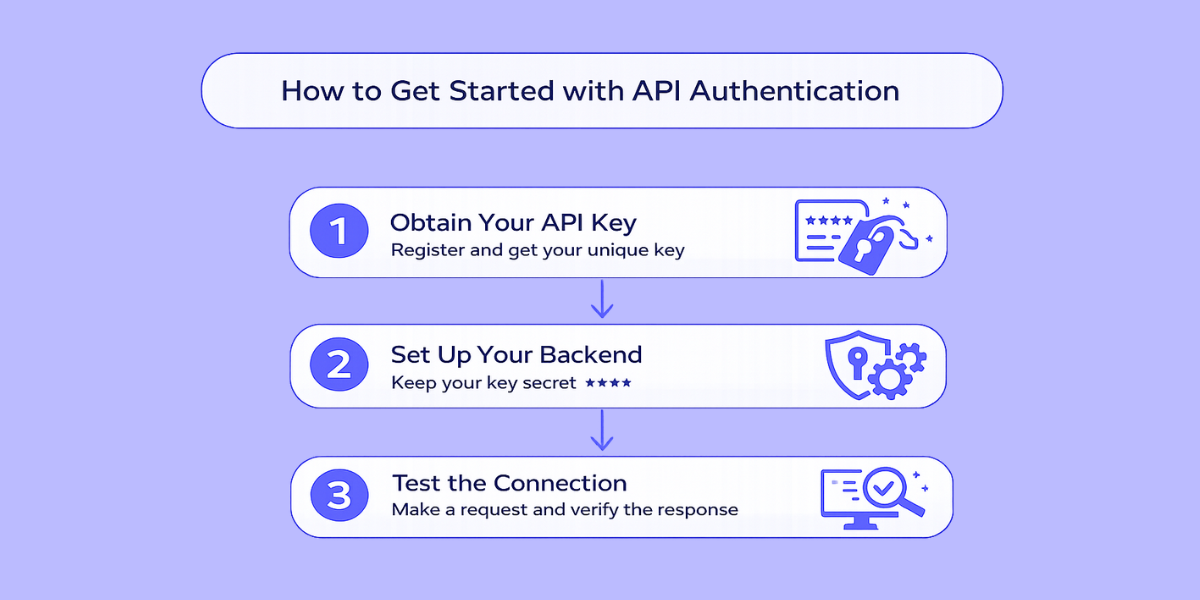
The process begins with registration of an api key. This is a key that is frequently transferred as an x api key. It identifies your account for a free api for commodity prices.
You can use the commodity price endpoints when making an api call. The API gives the current price. It also gives you back the opening price and closing price of your requested assets.
Helpful Resource: Best Use Cases Of API Commodities In Finance, ERP, And Supply Chain Apps
Key Categories Of Commodities Supported
The data that is needed in different industries varies. This API includes 130+ symbols, whether you require the price per metric ton or troy ounce.
Category | Examples | Typical Unit |
Energy | Crude oil, natural gas, heating oil | Barrel / MMBtu |
Precious Metals | Gold, Silver, Platinum | Troy ounce |
Agriculture | Soybean oil, palm oil, crude palm oil | Metric Ton |
Industrial Metals | Iron ore, Copper, Aluminum | Metric Ton |
The commodity prices are easily tracked using a free api for commodity prices. Even other significant cryptocurrencies can be tracked in case of an expansion of your project.
Technical Features And Endpoints
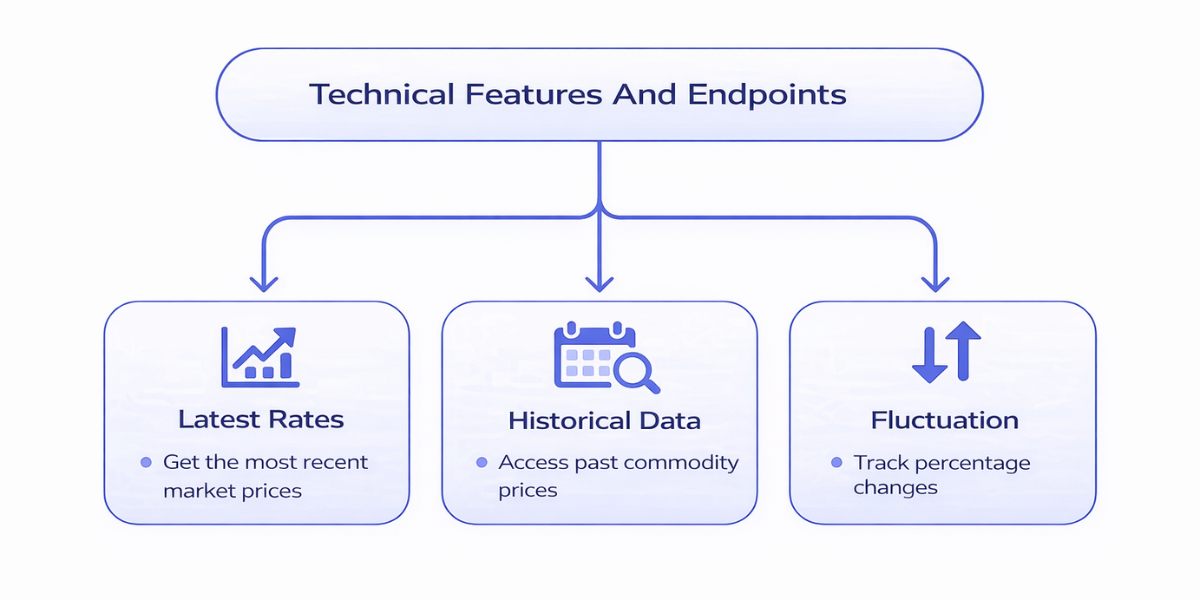
The CommodityPrice API offers various api endpoints in different applications. Both endpoints are provided with scalable volumes of traffic. It also works well as a free api for commodity prices for testing and early-stage builds.
You are able to fetch the most recent rates, request particular symbols and retrieve historic information when you need backtesting. The majority of endpoints respond with clean JSON, and thus, it can be easily integrated with Python, Node, or a BI tool. Calls are not limited by plan size and you can increase the plan as the size of your app increases.
Latest Rates Endpoint
This is your lightweight open source api for real-time commodity price API. It provides the most up-to-date market value. With the subscription plan, updates may be as frequent as every 60 seconds.
Historical Data Endpoint
Need to see what gold cost in 1995? You are covered by the historical commodity price api. You give it a date, and it gives you the historical data. It contains the maximum price and the minimum price of this day.
Fluctuation Endpoint
This assists in keeping track of fluctuation data. You are able to observe the performance of a given commodity over a given time period. It automatically calculates the average median rate and percentage change.
Helpful Resource: Detecting Commodity Price Fluctuations For Smarter Trading Decisions
Practical Coding Example: Python Integration
Now, let's examine some intuitive code examples. Python will be used to determine the current price of crude oil and natural gas.
import requests

# Your unique api key

api_key = 'YOUR_X_API_KEY'

url = f'https://api.commoditypriceapi.com/v2/rates/latest?symbols=WTIOIL-FUT,NG-FUT'

headers = {

    'x-api-key': api_key

}

# Making the api request

response = requests.get(url, headers=headers)

data = response.json()

if data['success']:

    # Accessing crude oil price

    oil_price = data['rates']['WTIOIL-FUT']

    print(f"Current Crude Oil Price: {oil_price} USD")

else:

    print("Error fetching data")
Here is the output
Current Crude Oil Price: 78.42 USDIt is a developer-friendly API that is compatible with nearly all programming languages. The JSON commodity prices can be easily read and incorporated into any UI. It also works well as a free api for commodity prices for quick testing and early builds.
Managing Your Subscription And Limits
All free commodity price APIs have a rate limit. This prevents server abuse. It also maintains a stable to all people.
- Free/Lite Plane: Provides a soft limit on requests.
- API Rate Limits: Typically 10 requests per minute with free accounts.
- Paid Plans: Ease these barriers in case of urgent requests.
- Billing Cycle: You have an option of paying on a monthly or an annual plan.
Plan your calls ahead of time when using a free api for commodity prices. Store the results of repeated reads. Add a default retrial strategy with backoff, and record errors to be reviewed.
On reaching your rate limit, the API sends a 429 error. The dashboard allows you to monitor your usage. The customer support team can assist you in upgrading to scalable volumes in case you require it.
It is better to set notifications about excessive use and reach the limit. Maintain heavy jobs on a schedule when it is off-peak. This will help you to prevent unsuccessful calls and ensure smooth dashboards.
Advanced Data Integration: Currencies And Units
The majority of financial institutions require exchange rate data delivered together with commodity prices. This API facilitates converting single currencies. It also provides exchange rates for 175 countries and above.
Custom Quote Currency
You aren't stuck with USD. You have an option of establishing a base currency, such as EUR or GBP. The API provides instant currency-to-currency conversion. It gives the values by using the midpoint data of global markets.
This assists you in reporting on prices in your domestic currency. It simplifies cross-border dashboards as well. It is only necessary to change the quote currency, but keep the same endpoints for commodity price feeds.
Data Reliability
Vetted exchanges are the sources of data. This guarantees that you receive rock-solid data sources in each of the api calls. It is similar whether you require iron ore or crude palm oil.
Good feeds minimize poor trading and procurement decisions. They also enhance backtesting and model training. Your alerts remain correct even when the market changes dramatically, especially when you rely on a free api for commodity prices.
Helpful Resource: Integrate Commodity Prices API into Your App in Minutes
TL;DR
- Free api for commodity prices with 130+ symbols.
- Real-time commodity price API, 60 sec updates.
- History of prices since 1990.
- REST API for commodities with simple JSON commodity prices.
- Friendly API with elaborate api documentation.
- Bank-level security of all financial data.
Conclusion
Any modern application depends on a correct selection of a free api for commodity prices. CommodityPriceAPI gives an adequate combination of speed and depth. No complex setup to give you real-time and historical data.
It covers precious metals, agricultural commodities, and so on. Commodity data integration is so simple, thanks to the straightforward api structure. A free trial option is available with an option of moving to paid subscriptions as the number of users increases.
You will never be alone with world class support team backing you. You can never be lonely with detailed api documentation. Create your next financial tool with certainty today using a free api for commodity prices.
Start small by testing a few endpoints, then scale as your needs grow. Add caching and alerts to keep your numbers stable during volatile shifts. This approach keeps your dashboards fast and reliable.
FAQs
Is There A Limit On The Free Plan?
Yes, the free api for commodity prices has a rate limit. It normally permits 2000 requests a month. You might require a subscription plan in case you exceed it.
How Do I Get My API Key?
Simply sign up on the website for a free api for commodity prices. The first trial will require no debit card data. Immediately, you will see your api key in your dashboard.
Which Commodities Are Supported?
The API supports 130+ items. This consists of crude oil, gold, natural gas, soybean oil, and iron ore. Many of these can be pulled both in spot and historical pricing.
Can I Get Data In Different Currencies?
Yes, you are able to select your preferred currency. The API offers exchange rate information for more than 175 world currencies. This simplifies the process of global pricing comparisons.
How Far Back Does Historical Data Go?
The historical commodity price api data is available up to the first of January 1990. This can be used in backtesting and trend analysis. It is also useful in checking forecasting models.