
Commodity Market API for Agriculture 2026: Real-Time, Historical & Free Options
By
Ejaz Ahmed12 Mar 2026 • 11 min read

Agricultural platform developers typically need real-time commodity pricing data, such as crops, energy products, and metals. A commodity market API allows them to use simple endpoints (via the REST protocol) and structured responses in JSON format to access the live and historical data of a commodity.
Developers do not need to collect data manually by visiting exchanges. Reliable commodity market data providers include services such as Commodities API, Financial Modeling Prep (FMP), Databento, and Polygon.io.
But they can access current prices, historical rates, and market variations in a few seconds with a commodity market API. It is possible to create dashboards, automatic agricultural pricing systems, and track global markets with reliable data.
In this guide, you will get to know how a commodity market API works. Moreover, how you can include it in your application, and how you can get real-time and historical commodity prices with the help of a simple API call.
What Is a Commodity Market API?
A commodity market API is a collection of endpoints that enables your application to obtain real-time and historical commodity prices without having to manually scrape websites. In 2026, there were some very good API services available that gave specialist access to commodity markets data. This helps in rapid prototyping and even high-frequency trading systems.
Therefore, no need to copy and paste the numbers. Your application calls the API and fetches the data in a structured JSON response.
These APIs range from agricultural products such as corn, sugar, and coffee to energy to precious metals. For instance, the FMP Commodities List API provides structured data on tradable commodities, allowing developers and investors to explore market options in real time.
Many also have exchange rates for international pricing and allow developers to manage usage through subscription plans. Different Commodities-APIs like CommodityPriceAPI, have different subscription modes with various pricing.
Most of the programming languages support the use of REST-based requests, such as Python, Node.js, and PHP. Some APIs, like Databento API, work with any language and can provide client libraries for any language, like Rust, Python, or C++.
Simply query the URL, get the most recent prices or historical data. After that, turn it into some actionable insights for your platform. Different programming languages like Python, C++, JavaScript, and Java allow the user to access the APIs through libraries.
If you're new to commodity pricing models, you can also check out our guide on Commodity Price Definition for Developers, which explains how market theory translates into structured data via APIs.
Why Use a Commodity Market API for Agriculture?
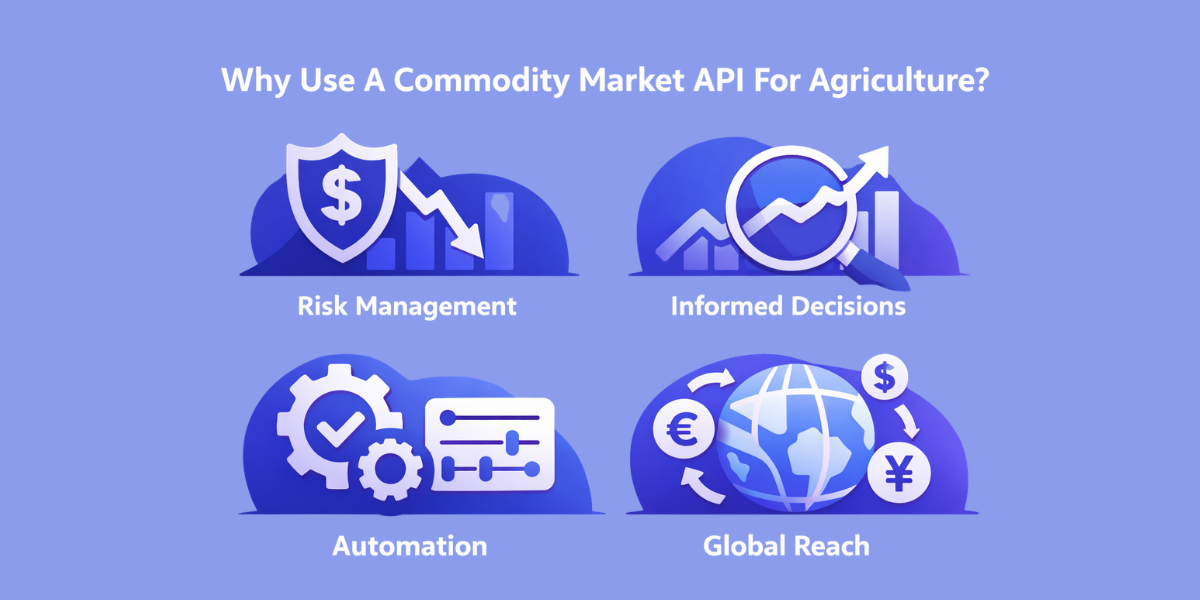
Agricultural markets are very volatile. Prices for commodities such as soybean oil or lean hog futures can move in a matter of minutes. Without a real-time commodity price API, platforms are at risk of providing old data, hence leading to poor decisions.
Major advantages of incorporating a commodity market API are:
- Risk Management: Farmers and traders use the live price fluctuations to hedge against losses.
- Informed Decisions Using Historical Data: To have good forecasting, get seasonal trends and historical price data.
- Automated Commodity Price Feeds: Get rid of the manual updates; the API ensures your platform always has the latest prices.
- Global Reach With Exchange Rate Data: Convert the international trading of commodities to local currencies in real time.
Comparison of Commodity Market Data Types
Data Type | Best Use Case | Frequency |
Live Data | Instant alerts and day trading. | Every 60 seconds |
Historical Prices | Trend analysis and reporting. | Daily/Monthly |
Fluctuation Data | Risk evaluation and volatility monitoring. | Specific date ranges |
Exchange Rates | Changing the prices to a preferred currency | Real-time |
How to Integrate a Commodity Market API
Integration is not as difficult as you may imagine. The majority of financial data vendors have a standard REST pattern.
Obtain Your API Key
To begin with, an api key of a financial data providers of commodities, such as CommodityPriceAPI, is necessary. This is a key that serves as your electronic ID.
Select the Appropriate Endpoints
The first step is to select your api endpoints. The most recent price of wheat is the /latest endpoint. To get historical price data back in 1990, use the /historical endpoint. The commodity market API manages data sourcing in global exchanges.
Ensure Bank-Level Security
Remember to have bank-level security. Do not reveal your key in client-side code, such as plain JavaScript. Your server should make the api call to discourage unauthorized use.
For a complete walkthrough, see our tutorial on how to integrate a commodity prices API into your application in minutes, including authentication and endpoint examples.
Example API Request for Latest Commodity Prices
To get the prices of commodities, developers need to make a simple API request to the latest rates endpoint. The API is a structured JSON of the most recent commodity prices and metadata. The API response is typically returned in JSON format, which can be parsed easily in most programming languages.
Example API Request
GET https://api.commoditypriceapi.com/v2/rates/latest?apiKey=YOUR_API_KEY&symbols=XAU,WTIOIL-FUT,XAGThis API request gets the latest market data on gold, WTI crude oil, and silver.
Example JSON Response
{
  "success": true,
  "timestamp": 1773206536,
  "rates": {
    "XAU": 5201.43,
    "WTIOIL-FUT": 104.91,
    "XAG": 88.13
  },
  "metadata": {
    "XAU": { "unit": "T.oz", "quote": "USD" },
    "WTIOIL-FUT": { "unit": "Bbl", "quote": "USD" },
    "XAG": { "unit": "T.oz", "quote": "USD" }
  }
}
This response contains the current price of commodities, units of measurement, and the quote currency. Developers usually confirm the request succeeded by checking the success or status field before processing the returned rates. Therefore, it becomes easy to add commodity market data to dashboards or any other analytics platforms.
Practical Code Example: Fetch Live Agricultural Prices via Commodity Market API
Python Script to Fetch Corn and Sugar Prices
The following example is a clean and functional Python-based example. This script retrieves the current price of corn and sugar in your base currency.
import requests

API_KEY = "YOUR_API_KEY"  # <-- replace with your real key
BASE_URL = "https://api.commoditypriceapi.com/v2/rates/latest"

params = {
    "apiKey": API_KEY,
    "symbols": "CORN,LS",
    "quote": "USD",
}

def get_market_data():
    try:

        response = requests.get(BASE_URL, params=params, timeout=20)
        data = response.json()

        if data.get("success"):
            rates = data.get("rates", {})
            if not rates:
                print("No rates returned.")
                return

            for symbol, price in rates.items():
                print(f"Commodity: {symbol} | Price: {price} USD")
        else:
            # API error message if provided
            err = data.get("error", {}).get("message", "Unknown API error")
            print(f"Error: {err}")

    except requests.exceptions.RequestException as e:
        print(f"Connection failed: {e}")
    except ValueError:
        print("Connection failed: Invalid JSON response")

if __name__ == "__main__":
    get_market_data()
Here's the output
Commodity: CORN | Price: 432.15 USD
Commodity: SUGAR | Price: 21.87 USD
JavaScript Example: Fetch Commodity Prices Using a Commodity Market API
JavaScript provides developers with the ability to create web dashboards to obtain commodity prices directly from a server. The following example has a basic API request using Node.js and the Fetch API.
const fetch = require("node-fetch");

const API_KEY = "YOUR_API_KEY";
const url = `https://api.commoditypriceapi.com/v2/rates/latest?apiKey=${API_KEY}&symbols=CORN,LS`;

async function getCommodityPrices() {
  try {
    const response = await fetch(url);
    const data = await response.json();

    if (data.success) {
      console.log("Commodity Prices:");
      console.log(data.rates);
    } else {
      console.error("API error:", data.error);
    }
  } catch (error) {
    console.error("Request failed:", error);
  }
}

getCommodityPrices();
The request gets the real-time commodity prices and presents them in the form of JSON. So it is not difficult to present the data in agricultural dashboards or analytics tools.
Key Categories of Commodity Market Data
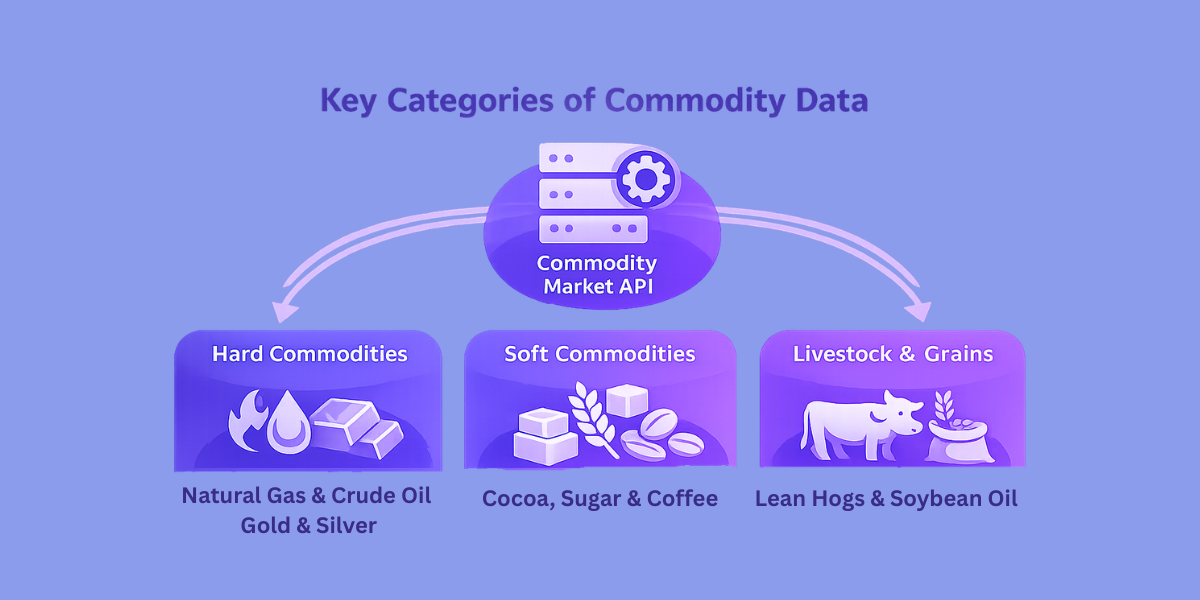
Not all data is created equal. With a commodity market API, you will have various categories. They all have a particular usage in an agricultural platform.
1. Hard Commodities
Usually, they are mine or extracted. This implies power derivatives such as natural gas and crude oil. Although they are not grown, they influence the price of farming costs in the form of fuel and fertilizers.
This also covers precious metals such as gold and silver, which are commonly inflation hedges. Some financial market APIs also extend coverage to digital assets such as Bitcoin and other major cryptocurrencies.
2. Soft Commodities
These are the centre of farming. We are discussing agricultural products that are cultivated instead of mined. Cocoa, sugar, and coffee are examples. So, these are measured in metric tons or bushels in the commodity market API.
3. Livestock and Grains
In this group, we have lean hogs futures and soybean oil. These play important parts in food supply chain platforms. You may bring midpoint data or the average median rate to present justifiable market data to your users using the commodity market api.
Advanced Features to Enhance Your Commodity Market API Platform
The basic commodity market price API provides you with figures. A great one gives you context. Find these features to make your platform unique.
For instance, Databento specializes in delivering low-latency futures market data designed for high-frequency analytics. Some advanced commodity APIs also support WebSocket connections, enabling continuous real-time data streaming instead of periodic REST polling.
Currency Conversion for Agricultural Prices
Agriculture is a global business. You may require exchange rate information to indicate the price of US corn in Euros. A commodity market api helps in accessing accurate exchange rate data in real time. All exchange rate data delivered by the APIs is midpoint data.
High-quality APIs convert single currencies within themselves. This allows you to receive the values at the current price in any currency of your choice, without making a second api call.
Historical Analysis for Informed Decisions
In order to construct charts, you have to get access to historical data. A commodity market api makes it easier to retrieve structured price history. The timeseries endpoint allows retrieving historical prices in the past year.
This assists the users in making informed choices on the basis of past performance. The highest price is easily noticeable during a harvest season.
Fluctuation Monitoring to Manage Risk
The fluctuation endpoint will be a savior to risk managers. Exchange operators like CME Group market data API provide top-of-book prices and market statistics directly from the exchange. A commodity market API, including a free market data API, can automatically calculate price volatility across different time ranges.
It is an automatic calculation of the change and changePercent between two dates. Advanced trading algorithms can even use such API feeds to trigger automated trades when predefined price thresholds are reached. You do not write complex math, as you allow the API to provide the volatility of the commodity market.
You can also learn how to detect commodity price fluctuations using API data to build automated alerts and risk monitoring tools.
Managing API Constraints and Scaling
You will reach api rate limits as your platform grows while using a commodity market api. This is a soft restriction or hard limit on the number of times that you can ping the server. This is one of the important issues to manage in order to ensure availability.
- Rate Limit: This is the number of requests per minute or hour.
- Soft Limit: An alert limit before you are disconnected.
- Rate Limits API: It is used depending on the plan, ranging from 2,000 to 50,000 calls.
In case you have any urgent requests, it is possible to upgrade to paid plans. These tend to provide specialized assistance and increased quotas for a commodity market api.
In the case of a good company, an annual plan may be more economical. Commodity-API gives a custom volume option for enterprise users, allowing tailored API request limits for large-scale applications. Look at the detailed api documentation to determine whether your key will be deleted automatically in case it is inactive.
Why Choose CommodityPriceAPI for Commodity Market Data?
This is a good choice in case you are interested in a lightweight open source API feel. It provides large corporations with power and flexible integration. You receive midpoint rates and live data that is updated at intervals of 60 seconds with a reliable commodity market api.
It has 130+ commodities and 175 + exchange rates. So, you can monitor the Gold rate, crude palm oil, and others. The data is obtained from rock solid data sources.
In many cases, Commodity prices data delivered by the API is collected from over 15 reliable data sources every minute. Ultimately, this guaranteed availability.
They have a customer support team that is accessible via chat and contact info. There are also fast onboarding and intuitive code examples. Test it with an indefinite free trial on scalable volumes. Different subscription plans for the Commodities-API also include a 7-day free trial for each plan.
CommodityPriceAPI Plan Comparison Table
Feature | Lite Plan | Plus Plan | Premium Plan |
|---|---|---|---|
Price | $15.99 / month | $34.99 / month | $149.99 / month |
Free Trial | Unlimited trial available | Unlimited trial available | Unlimited trial available |
API Calls / Month | 2,000 | 10,000 | 50,000 |
Update Frequency | 10 minutes | 60 seconds | 60 seconds |
Symbols Per Request | Up to 5 | Up to 10 | Up to 20 |
Rate Limits | 10 requests / minute | No strict rate limit | No strict rate limit |
Historical Data | Available since 1990 | Available since 1990 | Available since 1990 |
Time-Series Endpoint | Yes | Yes | Yes |
Fluctuation Endpoint | Yes | Yes | Yes |
Custom Quote Currency | Default currency only | Yes | Yes |
Support | Standard | Priority | Dedicated |
Some commodity APIs, like Metals-API, do not allow the user to simultaneously hold both a monthly and an annual plan. Mostly subscription plans are billed in advance from time to time, such as monthly or annually.
TL;DR
- A commodity market API can help access historical data and real-time data.
- It assists precious metals, energy future, and agricultural products.
- It is easy to integrate JSON commodity prices and a REST API.
- Major areas comprise currency conversion, historical, and fluctuation data.
- CommodityPriceAPI offers a secure, bank-level, and credible source of information.
Conclusion
A modern agricultural platform requires more than a good UI to be built. It needs real-time information that users can trust. As a commodity market API offers transparency in volatile markets while working through the same api endpoints across multiple data requests.
This assists farmers in selling at the best price at the right time. Moreover, it helps traders manage risk more efficiently and make confident moves.
Fluctuation data strengthens decision-making and supports long-term planning. In addition, secure integrations help protect sensitive financial information, including debit card data, during transactions and reporting. The platform helps in better global commodity tracking by supporting pricing in standard units such as troy ounce.
The method is simple and provide developer-friendly API. Register, receive your API key, and start making calls without complex setup. Meanwhile, you can also explore other endpoints to access additional features as your platform grows.
The world class support team backs the platforms to ensure faster onboarding and smoother implementation. As a result, you can build and test prototypes in minutes using clear and structured API documentation.
FAQs
What Commodities Can A Commodity Market API Track?
You can track more than 130 commodities, including agricultural products such as corn, sugar, soybean oil, and energy futures such as crude oil and natural gas. Precious metals such as gold and silver are also backed.
How Often Is Commodity Market Data Updated Through The API?
The rate of updation of commodity data depends on your selected plan. The Lite plan provides 10-minute updates, and for Plus and Premium plans, you get 60-second updates, so that your platform always has current market prices.
Can I Access Historical Commodity Prices Using A Commodity Market API?
Yes, definitely, the Commodity Market API is used to get historical price endpoints starting from the year 1990. This helps you to analyze trends, uncover seasonal learnings, and make informed decisions for agricultural pricing platforms.
Can A Commodity Market API Convert Prices Into Different Currencies?
Yes, there are more than 175 currencies supported by the API. You can define a base currency, and it converts prices to the desired currency in real time without having to make multiple API calls.
Is There A Free Version Of A Commodity Market API Available?
Yes, there is an unlimited trial available for free in the API to test the API. You can incorporate endpoints and access features before committing to a paid plan.
How Do Developers Handle API Errors And Rate Limits?
Standard HTTP codes are used. On surpassing rate limits, a 403 error is returned. To have more API calls must upgrade to higher plans or refer to the detailed API documentation for handling responses.